

Tests show four times ‘official’ level of grease in waterways

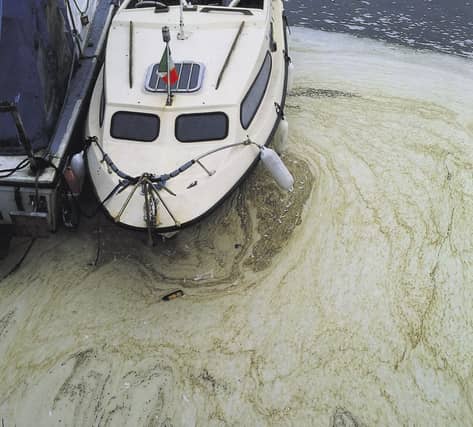

Boat owners in the Claddagh have taken their own water samples which show over four times the level of grease compared to the City Council tests.
The discharge of oils, fats and greases into the city’s waterways has been an ongoing issue for many years, but the upgrade of the sewage system on Lower Dominick Street which connected up businesses and homes to the public sewer was meant to have solved the problem.
However, while the raw sewage being pumped into the water became a thing of the past before the influx of international visitors for the Volvo Ocean Race, residents insist the problem of ugly deposits of grease floating around the Claddagh Basin became worse with the increase in eateries across the west end area of the city.
Michael Coyne, who has been one of the most vocal campaigners on the problem, met with officials in June after a meeting was arranged by local councillor, Catherine Connolly.
They did a site survey and took a sample, which showed the levels of fats, greases and oils was 50mg/L, which they said was well within normal levels.
“We had to laugh. To be honest it made us mad. I don’t know where they took the sample from but it wasn’t the Claddagh Basin. We decided to take matters into our own hands and get our own tests done,” stated Michael.
The samples sent to the Health Service Executive (HSE) laboratory were taken from three locations in early June – the Canal at Dominick Street, which showed a level of 84mg/L; Claddagh Bankeen Corrib, which registered at 8mg/L and Claddagh Quay, that came back at 214mg/L.
“The lab technician told us that 214mg/L was definitely pollution, poison. All you have to do is go behind Dominick Street and look at the wastewater on Eglinton Canal and you’ll see the pollution.”
Cllr Connolly said she was satisfied with the response of officials, who promptly came to meet with residents and conduct tests.
She had sent the residents’ test results to Irish Water and they accepted there as a big difference in levels.
Cllr Connolly said work on connecting properties to the public sewer meant that there were no longer direct discharges of sewerage or grease into the canal.
Workers had used the lower water levels in recent weeks during work on the locked gates to double check that no discharges were going into the canal.
“So why is there still grease in the canal? It would seem it’s not there all the time. This could be somebody dumping this into the water. It could be coming from further upstream, it could be from one of a number of streams feeding into the canal,” she insisted.
“It’s very hard to catch anyone doing this. It’s like littering. It’s an education process, like with litter.”
Irish Water are due in January to introduce a licensing system for food businesses which would make it compulsory for them to install a grease trap.
However, this would reduce blockages in the Mutton Island sewerage system rather than the surface water of the canal.
“As a councillor, I was delighted the raw sewerage finally stopped being pumped into the canal. There are still one or two discharges on Nun’s Island. That’s real progress,” she stated.
“Hopefully when the licensing system is introduced it will raise awareness about dumping oil into the water.”
She had asked officials to install a boom near McGuire’s Daybreak Shop which prevented surface water going into the Claddagh Basin.
“This also serves to bring to people’s attention the outcome of dumping into the water.”
A spokesperson for Galway City Council said the licensing system may well have an impact on surface water as it would ensure any businesses that sell hot food would have to show they are properly disposing of grease.