

Salt therapy lets asthma sufferers breathe easy

Date Published: {J}
When you suffer from asthma and hay fever – an estimated 470,000 Irish people do – feeling under the weather is a regular occurrence. In winter you are more likely to get chest infections. In summer, if you also suffer from hay fever, as people with asthma often do, you can face days of sniffling, sneezing and watery eyes.
And it’s not just people with asthma who get hayv fever – according to the Asthma Society about 15 percent of the population suffer from the condition.
It isn’t pleasant. And while the medication available to sufferers has improved hugely over the years, a lot of us who suffer wish there was a less ‘chemical’ way of clearing our respiratory systems.
Hence the growing phenomenon of halotherapy – otherwise known as salt therapy – in the Western world, with a recent addition in Galway being the Salt Spa in the city’s Radisson Hotel.
The idea of gargling salt water for sore throats or using saline nasal sprays to relieve congestion is pretty familiar, but halotherapy takes it to a new level.
My first experience of breathing salty air was during a visit to Warsaw Salt Mines a couple of years ago. Deep underground, the air was so clean you could actually feel it entering your system. The mines are a major tourist attraction in the region, both for their amazing underground cathedral and the reputed benefits their salt offers to people with respiratory disorders.
The idea that salt had health benefits was first highlighted by a Polish doctor, Felix Bochkovsky in 1843, when he was dealing with patients in salt mines in the Ukraine. His research indicated that the people working in salt mines didn’t suffer from colds and respiratory diseases despite working in harsh conditions and having poor nutrition.
Since then, the idea of using natural salt caves – speleotherapy – has spread and it has been used in Eastern Europe for generations. It is especially popular in Russia. In fact, it was in Russia, in 1987 that a system was developed using underground salt rock that had been shaped into blocks.
That technique allowed the atmosphere of the salt mines to be recreated above ground. It was further developed into halotherapy in which a saline diffuser releases salty air into a special room where the walls and floor are covered by layers of salt. The machine produces and maintains the required level of natural concentration of salt micro-particles to create similar conditions to those found in salt mines. These are small enough to penetrate deep into your lungs.Ireland has only adopted salt therapy relatively recently, with the first cave being opened at Maynooth in early 2009 by Dr Tamas Bakonyi, a GP from Hungary involved in a practice in Leixlip.
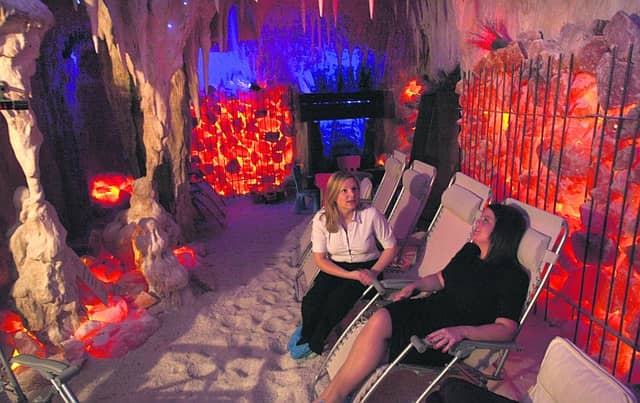
The Radisson is one of two salt caves that opened in Galway this year and while it’s designed to offer relief from various ailments, it also comes with certain luxuries, including soft lights, music, a salt waterfall and – most impressively – stalactites hanging from the ceiling. And there’s a 15-minute ventilation period between each session to allow the room to be purified and germ free for each new group.
Ann McDonagh, the manager of the Radisson’s Spirit One Spa, explains that the salt spa was the brainchild of the hotel’s former manager, Stephen Kennedy, who first experienced these treatment rooms in Central Europe and decided to introduce the concept to Galway. But, while some of them are minimal in design, the Radisson went for more add ons.
For more, read this week's Galway City Tribune.