

Papacy and politics are impossible to separate

World of Politics with Harry McGee
Never mix sports and politics, they say – but how can you avoid it? Sport is political. In fact, everything is political, or touches on politics. That same is true for religion. It’s inextricably linked with the political history of the State. I grew up in a generation where the influence of the Catholic Church was just beginning to wane, and there was the first sign of rust on its iron clasp on Irish society and morals.
As a kid, we said the Rosary most nights at home. There were 'stations' (Masses) at houses in the parish – all houses had their turn.
In my school, there was still a large number of priests and brothers, working in the parish or as schoolteachers. I was an altar boy when in primary school. I remember arriving to serve Mass in the Jes on Sea Road on a Sunday evening only to discover to my horror that the Mass had started at 7pm and not 7.30pm as I thought.
Brother Bonfield, who was in charge of arrangements for Mass, told me there was a Mass in the Claddagh at 7.30pm. I remember cycling furiously down to St Nicholas Church, fearful that otherwise I would be cast into Hell. I was ten, maybe eleven, at the time.
Even then the Church was on the wane, and the secrecy that had surrounded some of its cruellest and unsavoury aspects was no longer as hermetically sealed.
When John Paul II came to Ireland in 1979, it gave a boost to vocations and re-energised the Church in Ireland for a few years. Over a million people turned out in the Phoenix Park for the Papal Mass there which was an extraordinary turnout.
There were also huge crowds in Galway for the Youth Mass, where the Polish Pope uttered the memorable phrase. “Young people of Ireland, I love you.”
Of course, there were straws in the wind there later. Two of the principals at the Galway Mass were Bishop Éamon Casey and Fr Michael Cleary, both of whom would be living double lives and would face disgrace and defenestration in later years.
By the time I finished my third level education in the late 1980s, that weakening of influence was becoming more obvious.
While the abortion referendum had been passed, there were signs that a growing minority of people in a society that had become somewhat wealthier, better educated and more urbanised railed against what was a very conservative society, that promulgated a restrictive and narrow moral view of family, relations, sex and personal autonomy.
I’ll divert for a paragraph or two to talk about Albania, which I visited during the Balkan wars in the late 1990s.
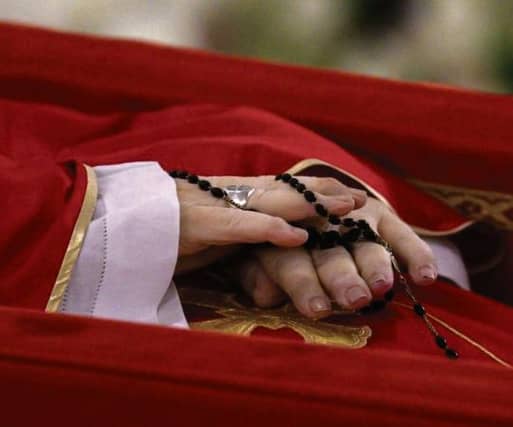
Pictured: His Rosary beads wrapped around the hands of Pope Francis.