

Democracy isn’t about taking the law into your own hands

World of Politics with Harry McGee
When I first saw the image of Venezuelan President Nicolás Maduro at the weekend, I was immediately reminded of another dictator — Saddam Hussein.
The photograph released by US authorities showed Maduro after his capture, blindfolded and wearing thick earphones, ostensibly to block out noise. But, as with Saddam, what was most noticeable was the heavy moustache and the passive expression.
Both men had exhibited brutality to retain power in their respective countries and their respective ousters were never going to elicit much sympathy. But it was the manner in which it was done that was so questionable.
It seemed to me that the passivity of those expressions signified that neither man was intimidated by capture by the Americans, nor by the fate that might befall them. In Saddam’s case, it was certain death.
There is not a day that goes by when we are not astonished by the next outrageous stunt of the Trump presidency. But why are we astonished? The stuff that causes outrage has been normalised.
Trump has taken the excess and hyperbole of his first term and doubled down on it. His strategies, to use his own malapropism, are even more “bigly”.
Some liken his style and modus operandi to a man starring in his own reality television show, which is where he came from. That comparison is superficial, and it insults the gravity of what is happening.
Trump is a disruptor, but not the kind who replaces old certainties with something better. Yes, he is shaking up established assumptions, but what is emerging in their place is bleak: the cosying up to Putin; disdain for Europe; disdain for science, medicine and basic human rights; and rhetoric that grows more bullying by the week, if not by the day.
Defenders will say this is just Trump being over the top, shooting from the hip — a dog whose bark is worse than its bite.
But there has been plenty of bite, particularly in foreign interventions, most of which appear to have little basis in international law.
The audacious capture of Maduro and his wife outside Caracas was, from a purely military perspective, a successful operation.
From what can be gleaned from reports, there were no US fatalities, although some soldiers were injured. By contrast, at least 40 Venezuelans were killed, including 32 Cuban soldiers who formed part of Maduro’s personal security detail.
His reliance on Cuban intelligence and security speaks volumes about the nature of the regime and the strong-arm tactics used to retain power.
Maduro is not a democrat, nor a particularly desirable leader. But he is the leader of a sovereign country. A state cannot simply swoop in and arrest another country’s leader on the basis that it deems him a criminal.
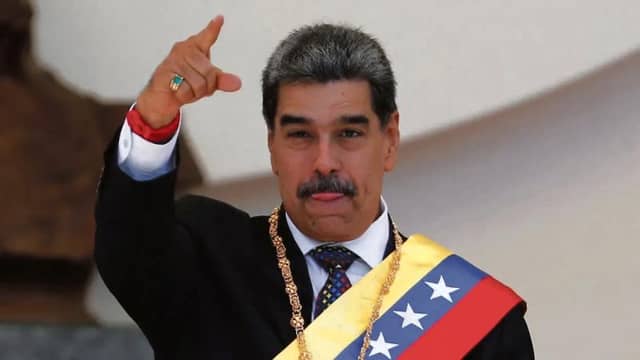
Pictured: Before the downfall... Venezuelan President Nicolás Maduro.