

Taoiseach faces White House tightrope walk

The outbreak of war in Iran last weekend has left the Irish Government facing a series of political challenges, both moral and practical. The first dilemma is how to respond to what is, in effect, a unilateral assault by the United States and Israel — undertaken without reference to the United Nations or any clear framework of international law.
Washington has struggled to articulate a coherent justification. Secretary of State Marco Rubio suggested the US joined Israel’s action because, had Israel acted alone, Iran might have retaliated against American interests.
Within hours, Donald Trump appeared to contradict that, claiming he had urged Israel to act — implying the initiative was his. The war aims remain opaque. At various points, Trump has spoken of regime change; at others, the focus has been on degrading Iran’s military capacity. The rationale shifts.
For Ireland and other European states, however, this has created a profound moral headache. The attack appears unprovoked and lacking clear legal mandate. How, then, is it fundamentally different from Russia’s invasion of Ukraine?
When Putin invaded Ukraine, the violation of sovereignty was unequivocal. Here, too, a sovereign state has been subjected to sustained bombardment.
The Irish Government has responded cautiously, walking a diplomatic tightrope. It has reiterated its support for a “rules-based international order”, though that phrase feels fragile. Ministers have noted the absence of congressional approval or UN authorisation but stop short of direct condemnation.
Part of that restraint rests on moral qualification. The Iranian regime has been repressive for more than four decades, systematically crushing dissent, persecuting women and minorities, and responding to protests with lethal force.
Tens of thousands are believed to have died in recent crackdowns. Few, as Simon Harris remarked this week, would mourn the passing of Ayatollah Ali Khamenei.
Yet removing a despotic leader by force remains an extreme step. And the motives of the US and Israel are hardly altruistic. They are strategic: securing regional dominance, protecting energy flows and reinforcing Israel’s security position. In blunt terms, this is about power.
That logic has been articulated openly by figures around Trump; in the real world, the most powerful prevail. There is no need, in that worldview, for elaborate moral justification. It is a transactional order in which strength determines outcomes.
To many in Europe, that represents a stark departure from the post-war consensus built on law, alliances and multilateralism. But it reflects a wider shift in global politics.
Beyond the moral dimension lies a pressing practical concern: Irish citizens caught up in the conflict.
Despite our size, there is a substantial Irish presence in the Gulf. More than 22,500 have registered with the Department of Foreign Affairs, many of them young professionals working in the United Arab Emirates and Qatar. Teaching and healthcare posts are particularly popular.
Dubai and Doha are also major transit hubs and holiday destinations. Since hostilities began, around 2,000 Irish citizens have found themselves stranded — attempting to return home or stuck in transit.
The Government has experience in evacuation logistics. Smaller operations were mounted in Iran last year and in Sudan in 2023, when more than 120 Irish citizens were extracted during its civil war. But the scale of any potential evacuation from the Gulf would be far greater and far more complex.
For now, the focus is on assisting those stranded rather than organising a mass withdrawal. A charter flight from Oman has already been arranged. Emirates has announced a Dubai–Dublin service that will allow more than 200 Irish citizens to return. Further flights may follow.
Whether broader evacuation becomes necessary depends on the trajectory of the conflict.
Militarily, the imbalance is stark. The US and Israel possess overwhelming air superiority and technological advantage. Continued strikes are likely to degrade Iran’s military infrastructure over the coming weeks.
Yet Iran retains substantial capacity. It has invested heavily in drones, ballistic missiles and proxy networks. Even advanced missile defence systems cannot guarantee full interception. Some attacks will penetrate.
The strategic question is the endgame. At what point does Washington declare its objectives met? A weakened Iran does not automatically translate into regime change. Nor does it guarantee long-term stability. History suggests that military intervention often produces power vacuums rather than resolution.
Indeed, the Middle East over the past half-century has been shaped by repeated western interventions — in Iraq, Libya and elsewhere — that removed regimes but failed to deliver stable governments. What followed were years of instability, sectarian violence and extremism. It is difficult to see why this intervention would defy that pattern.
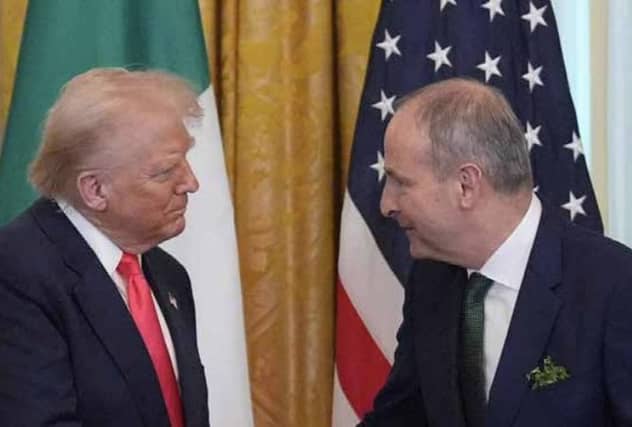
A diplomatic minefield awaits Micheál Martin when he visits the White House. He will be expected to articulate Ireland’s unease. His previous Oval Office meeting was marked by restraint bordering on passivity. This time, expectations are higher. He will need to stand up and be counted.
Ultimately, the crisis forces uncomfortable questions about the direction of global politics, of whether the world is entering an era in which power alone determines legitimacy.
If that is the case, then the rules-based order that Micheál Martin and his ministerial colleagues talk about so often in these debates will become moot - just a word formula that means nothing.
Harry McGee is political correspondent of the Irish Times.