

SF’s Cathal Ó Conchúir to top poll – in Indonesia!

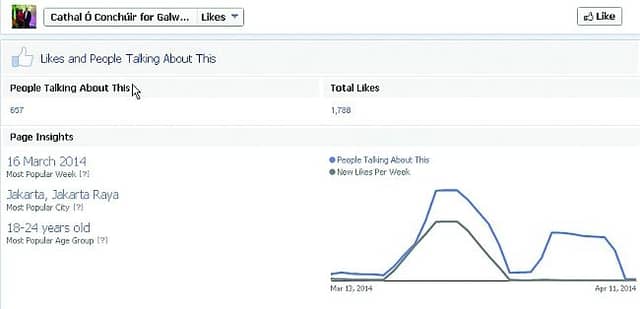

As well as in newspapers, on radio, on lampposts and at doorsteps, the battle for your vote during this year’s local elections is, to a lesser extent, also being waged over the internet.
Most candidates now have websites and blogs and Twitter accounts and Facebook pages.
Futile the lot of them, if you ask us – a million Facebook likes won’t equate to one single extra vote.
But politicians like to keep up with the times and even if they know social media isn’t necessarily going to win them an election, they reckon it can hardly hinder them.
Some candidates are more internet savvy than others but they’re all chasing the elusive ‘youth vote’.
For those sane readers among you who live real lives as opposed to imagined makey-uppy ones on social networking sites, and who aren’t familiar with the warbling of politicians on Facebook and Twitter: You are the lucky ones. Keep it that way.
Here’s a small synopsis of how it works: Candidate sets up Facebook page or Twitter account. People are encouraged to ‘like’ their FB page or ‘follow’ them on Twitter.
If you’re gullible enough to do that – and are a sucker for punishment – you will receive regular updates from that candidate about his or her election campaign.
It’s usually the puff-piece and propaganda nonsense that no other media organisation would bother using.
The Facebook and Twitter battle inevitably turns into a popularity contest: Mature playground stuff like ‘I’ve got more ‘likes’ than you’ is the sort of one-upmanship of social media savvy politicians or politeratti.
Some haven’t many likes or followers, so in order to ‘boost’ their likes – and the perception that they are more popular than they actually are – they buy likes.
Yes ladies and gentlemen, politicians are stupid enough to actually pay money to companies who in return give them ‘likes’ and ‘followers’.
Fair enough, you say. Except the ‘likes’ and ‘followers’ you buy are generally from dormant accounts, fake accounts or accounts of people who are not even living in Ireland.
And more importantly these fake likes and followers can’t vote and are purchased purely to give the impression you are more popular than you are.
For more, read this week’s Connacht Sentinel.