

Harpist who conquered world happy with Aran life

Date Published: 15-Nov-2012
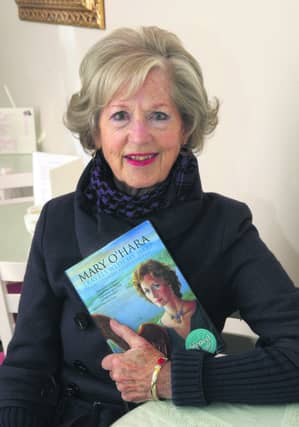
For a person who is adamant that she lacked ambition, Mary O’Hara’s life has been more action packed than most.
At the height of her career, the Sligo-born singer and harpist filled out venues from Carnegie Hall in New York to London’s Royal Albert Hall. She also fronted television series for BBC and ITV and featured regularly on The Late Late Show here at home. She spent over 12 years in a convent, entering in the early 1960s, after the death of her first husband Richard Selig. Years later, after she married her second husband, Inis Mór born Pádraig O’Toole, the couple spent several years in East Africa where he worked as a teacher.
She and Pádraig now live on Inis Mór and although she doesn’t sing any more, Mary certainly isn’t idle.
She has recently penned her autobiography, Travels with My Harp, a fascinating account of her life and music and just last week she was conferred with an honorary Masters from NUIG at its campus in her home town in Sligo.
She has also published her harp accompaniments in five volumes and gives presentations on these in Ireland, England, Wales, Australia, USA and Canada.
While she might not be so well-known among young people these days, Mary’s star was so high in the 1980s that she was immortalised by Christy Moore in his popular folk song, Lisdoonvarna with “Mary O’Hara and Brush Shiels together doing the Four Green Fields”.Today, in her mid 70s, she’s a tall, upright woman, still glamorous, and her personality is an easy mix of determination and humour. “Everything that has happened in my life, I’ve been thrown in at the deep end,” she says, agreeing with her husband Pádraig when he says “Mary tries to get out of most things”.
She became a professional singer and musician “by default”, she explains, recalling an episode from her youth that continues to amuse her.
“My sister Joan (O’Hara, the actress), was so concerned about my lack of a plan that I qualified as a beautician to satisfy her. But I did nothing with it.”
Joan then decided Mary should go to the College of Art in Dun Laoghaire, where “I had a great social life, but not studying”.
Mary, who began learning piano at eight, took up harp in her teens and quickly gained a reputation as a fine singer of Irish traditional songs, who accompanied herself on the harp, an instrument which had been in severe decline until she had helped to revive it.
As a result, Radio Éireann offered her regular work, which paid well. That led to invitations to perform countrywide, so by the early 1950s, the teenager’s career was becoming established, albeit accidentally.
Around the same time, Mary performed in the Edinburgh Fringe Festival, and was invited to participate in the official festival the following year. She also signed up to the Decca record label. It was a heady time for the young Sligo girl.
When she was 20, the BBC invited her to take part in a television programme in London, as a result of which she was given her own show, The Starlight Series, a primetime slot on Saturday night television.
There was also a brief spell modelling and studying ballet before music became the complete focus of her professional life.
Personally, things were going well too. By 1956, Mary was married to a young American academic and poet. Richard Selig was a Rhodes Scholar in Oxford and an admirer of WB Yeats. They had met in Dublin through the poet Thomas Kinsella.
For more, read this week's Galway City Tribune.