

Galway population grows – and pays its share


The population of Galway grew by just over two per cent over the past year – with an almost equal balance of growth between city and county. That’s according to the new County Data Dashboard unveiled by the Northern and Western Regional Assembly which provide up-to-date data on all eight counties in the region.
It shows that the population of Galway was 292,700 as of 2025 – up 2.1 per cent on the previous year.
Both council areas recorded growth, with Galway City Council up 2.2%, while the population of Galway County Council was up 2.1%.
And we spent more money too; the value of domestic card spending in Galway amounted to €3.2 billion in the twelve months to January 2026, up 3.4% compared to last year.
The number of people working in Galway was just over 160,000 while the number of young people on the Live Register in Galway was down marginally, by 0.4 per cent, year-on-year in February 2026.
The number of people recorded on the Live Register in the Galway County Council area in February 2026 was down 3.8 per cent over the previous year, while the number of people registered on the Live Register in the Galway City Council area was down 0.6 per cent on an annual basis.
Galwegians also played their part in contributing its share to the Exchequer; the level of Income Tax, PAYE and USC receipts generated in Galway amounted to €1.2 billion, up 10.3 per cent on last year.
And to no one’s surprise, although new dwelling completions continue to rise in Galway, housing costs continue to increase in the county, with the median house price in Galway up 14.7 per cent to €378,374 as of January 2026.
But householders are also looking to invest in green energy. A total of 2,063 properties in Galway had solar panel installations supported by the SEAI in 2025, up 8.2% compared to last year.
At the same time, 17.4% of all new private car registrations were fully battery powered EVs in the twelve months to February 2026.
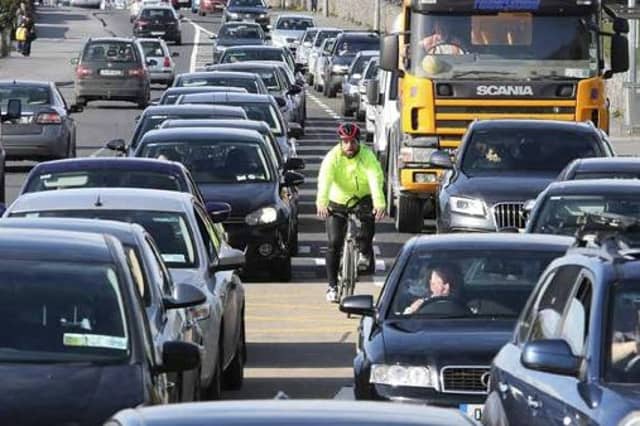
Again to no one’s astonishment, traffic congestion across a number of roads in Galway were higher in 2025 compared to the previous year, with the highest increase recorded on the N17 Tuam Bypass.
Across the region, the NWRA County Data Dashboards will display the latest datasets on Cavan, Donegal, Monaghan, Leitrim, Sligo, Roscommon, Mayo and Galway.
For each county, these data dashboards will focus on the latest trends regarding population, economic development patterns, housing, the transition to a low carbon society and transport, with the data also available at a national level allowing for comparisons against national norms.
The NWRA says that development of the County Data Dashboards stems from the fact that there is a lack of up-to-date county datasets readily available in the public domain, with Local Authorities, stakeholders and the public having to rely on often outdated Census and other information.
We will continue to use this data to advocate on behalf of the Northern & Western counties
These data dashboards will provide information that will assist users in monitoring statistics, identifying emerging challenges and opportunities, monitor growth patterns, preparing funding applications, and promoting counties/the Region, to name just a few potential uses.
Such information will assist stakeholders in their submissions on the recently launched consultation of the new Regional Spatial and Economic Strategy of the Northern and Western Region of Ireland, with deadline for the receipt of submissions and observations being Friday, May 22.
The RSES is an important statutory document for the long-term strategic planning for the spatial and economic development of the Northern and Western Region of Ireland.
Its brief is to set out how the region should grow sustainably, to determine where investment should be focused and how national policy should be delivered at a regional level over the next 20 years.
Acting Director of the Northern and Western Regional Assembly Conall McGettigan said that they had has built a solid track record in regional economic and social analysis.
“We will continue to use this data to advocate on behalf of the Northern & Western counties, as well as utilising the information in formulating regional spatial and economic policy,” said the Acting Director.
“With the review of the RSES now commencing, the addition of the County Dashboards is opportune,” he added.
NWRA economist John Daly said that the introduction of the Dashboards ‘marks a step change in how we gather and present county data in the region, providing our stakeholders with up-to-date county datasets that can be viewed in a digestible format and that can easily identify emerging challenges and growth areas in each county’.
“By collating datasets from the CSO, the Central Bank of Ireland, the SEAI and other institutions into one set of dashboards, we can provide a clear picture of the latest developments in each county across a host of areas,” he said.
It also provides policymakers an innovative tool that will assist them in further supporting economic development in the region
"It also provides policymakers an innovative tool that will assist them in further supporting economic development in the region,” he added.
Nationally, the population of Ireland was 5.5 million as of 2025, up 1.5 per cent on the previous year.
The number of people working in Ireland was around 2.8 million, albeit the number of young people on the Live Register in Ireland was up 10.5 per cent year-on-year in February 2026.
Again, although new dwelling completions continue to rise in Ireland to just over 36,000 in 2025, housing costs continue to increase across the State, with the median house price nationally up 6.8 per cent to €390,000 as of January 2026.
A total of 33,522 properties in Ireland had solar panel installations supported by the SEAI in 2025, up 17.4% compared to last year.
And on the move to green motoring, a total of 21.1 per cent of all new private car registrations were fully battery powered EVs in the twelve months to February 2026.