

Galway native finds a new planet!
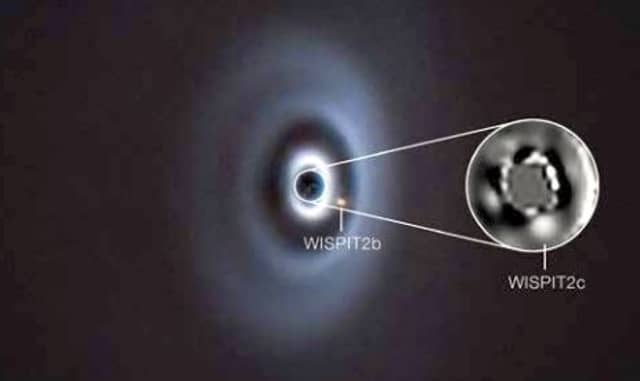

An international team of astronomers, led by a Connemara-born PhD student at University of Galway, have made the groundbreaking discovery of a second planet in the same system where they discovered another planet last year.
Detected at an early stage of formation in the disc around a young star, the young planet named WISPIT 2c is estimated to be about five million years old and most likely ten times the mass of Jupiter.
The star, WISPIT 2 is located in the constellation of the Eagle, which is visible from Galway in the summer and autumn months towards the southern horizon.
This major find for the field of astronomy makes WISPIT 2 only the second-known young (and still forming) multi-planet system. WISPIT 2 may resemble the young Solar System with now two gas giant planets embedded in its multi-ringed dust disk.
This includes the now confirmed planet WISPIT 2c and the planet WISPIT 2b which was discovered last year by the same research team (led by PhD student Richelle van Capelleveen at Leiden Observatory and Dr. Laird Close from the University of Arizona).
The new planet is a very young gas giant based on the temperature and its radius from the atmosphere spectrum. It is twice the size of the previously detected WISPIT 2b and orbits four times closer to its host star, which makes it incredibly difficult to detect with ground-based telescopes.
The study has been published in Astrophysical Journal Letters.
The presence of this second planet was detected using the European Southern Observatory’s (ESO’s) Very Large Telescope in Chile’s Atacama Desert. By linking several telescopes together to act as one giant instrument, the research team was able to observe regions very close to the star.
The team detected carbon monoxide gas, a chemical that is commonly found in the atmospheres of young giant planets. Carbon monoxide leaves a strong and distinctive chemical signature in telescope data, providing the crucial evidence needed to confirm the planet’s existence.
At first, we weren’t sure if it was a planet or a very large dust clump
The study was led by PhD student and Renvyle native, Chloe Lawlor from the Centre for Astronomy at the School of Natural Sciences and the Ryan Institute at University of Galway, in collaboration with Postdoctoral researcher Guillaume Bourdarot, Max Planck Institute for Extraterrestrial Physics in Garching, Germany and PhD student Richelle van Capelleveen, Leiden, Netherlands.
“After the initial discovery of WISPIT 2b, which I was also involved in, we suspected there might be another object in the system,” said Chloe Lawlor.
“At first, we weren’t sure if it was a planet or a very large dust clump. We very quickly made follow-up observations using the Very Large Telescope Interferometer, an incredible setup where multiple telescopes can be connected to form a large virtual telescope. This allowed us to take what we call a spectrum, which is essentially a chemical fingerprint, revealing the elements and molecules in an object’s atmosphere.
“There was definitely an element of disbelief. I didn’t expect to be the one to find a second planet in the system. When I sent the spectrum to my supervisor Dr Christian Ginski, it was a huge shock and upon further examination, he confirmed I’d found a planet!
“WISPIT-2 will become an important laboratory to study planet formation.”
The research team used the European Southern Observatory’s Very Large Telescope Interferometer, capturing an image of the object and allowing also for the first study of its atmosphere.