

Homeless hub marks new era in housing
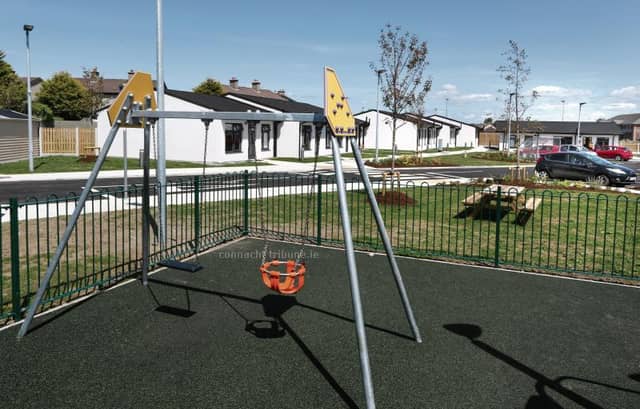

The Peter McVerry Trust has been at the forefront of the fight against homelessness in the capital for almost 40 years. In recent years, it has widened its scope by expanding to the regions and last month, opened its first facility in Galway.
The launch of the Modular Family Hub in the Westside heralds the start of a new chapter in rowing back the tide of homelessness that the city has been dealing with for the past decade – with the Peter McVerry Trust hoping to assist with the Trojan work already being done by charities such as COPE Galway and the Simon Community.
CEO of the Trust, Pat Doyle, says the hub – consisting of fifteen self-contained modular build units – is just the start of their work in the West, with work already underway to source homes for purchase and establish a regional office in Galway City.
The €1 million Family Hub, which welcomed its first families over the past couple of weeks, is made up of two and three-bed modular homes to provide transitional accommodation to families as they seek to find secure accommodation – keeping them out of emergency accommodation and avoiding its many pitfalls, as Pat explains.
“The Westside Family Hub was a pilot project with the Department of Housing and Galway City Council, and we were asked to come on board as partners. The units have a 60-year lifespan and meet all the needs of families.
“We have a family resources unit on-site that’s staffed 24 hours a day, where there’s a family consultation area where we can work with families to arrange move-ons and put in place supports,” says Pat.
The facility is fully equipped with outdoor and indoor children’s pay areas, laundry facilities and each unit has a kitchen and space to allow normal family life to carry on – giving children space to do their homework that they wouldn’t have if they were living out of a hotel room.
“We did some work with families looking at their experiences of emergency accommodation in hotels and B&Bs and the experience for them is traumatic. We asked what the most difficult part of it was for them. Families told us that having no facilities to cook was a particular challenge, and if there was somewhere, they might only have access to it once a day.
“They also told us one of the things was having no facility to do laundry. It can be very expensive to be homeless when you have to send out your laundry all the time to get it sorted, or if not, you’re trying to wash it in the en suite bath,” Pat explains.
The Peter McVerry Trust has fifteen family hubs across Ireland in Dublin, Meath, Louth and now Galway – and they have proven very effective.
“What we made sure we had in all of them was to have separate sleeping accommodation for children so Mam or Dad, or Mam and Dad, had a separate sleeping space – one woman told us that the night she moved in, it was the first time in months that she didn’t have to go to bed at 8pm because her and the children weren’t in the same room,” says Pat.
The charity’s first hub was at Hazel House in Glasnevin where it has thirteen units. Nine families moved through the unit on to more permanent accommodation within six to nine months last year, leading Pat to believe that the Galway facility, with its fifteen units, could see 30 families access secure accommodation within a year.
“The next challenge, once the families are in the hub, is helping them to move on.
“There is a heating and electricity meter in each unit so that residents can learn skills, if they haven’t already got those budgeting skills. Each family will pay a differential rent,” says Pat, explaining that the amount paid is assessed in the same way as rent is calculated by local authorities.
Part of what the Peter McVerry Trust does is to ensure that there is adequate suitable accommodation for families to move into, and through building, buying and leasing properties, families with significant challenges are catered for by the charity as an approved housing body, says Pat.
“Sometimes there are significant challenges, for example, sourcing a five-bed house, or there could be other issues that might make moving-on from a hub take a bit longer. One family might need a house for a person with a disability, but the average is six to nine months.
“If we have a family in Galway who has a particular difficulty, we will buy, lease or build a property. We have identified five potential building sites in Galway and we already have a line of sight to a number of key properties in Galway for purchase. We haven’t landed them yet, but they’re identified.”
When the Peter McVerry Trust went into Limerick in 2016, it had two properties – it now has 50 and is in the process of adding another 40 to that portfolio.
“Our job in Galway will be to lend a hand to the local authority to build and buy property to assist with the housing waiting list,” says Pat.
Galway suffers the same issues as many cities, where there is a shortage of accommodation due to it being a university city with a large hospital – two elements that put severe pressure on the housing market.
“We’re only there [in Galway] about a month but we are hoping over the next few years to develop a portfolio of 100-plus properties. We’re also identifying an office in Galway and we’re in full consultation with the local authority.
“We also do a number of re-builds – there’s a scheme called the Repair and Leasing Scheme. There are a number of properties in need of renewal in Galway and you enter a contract with the Council to do that work, but the landlord must lease it back for at least ten to twenty years and it has to be social housing,” says Pat.
The Trust has already identified a brownfield site in the city for development, he adds. “We identify opportunities and bring them to the Council to see if it can be made to work.”
Reflecting on the current circumstances in light of Covid-19, Pat says it’s inevitable that there will be an impact on housing – with building costs likely to increase by ten to fifteen per cent, but it was a question of priorities for the incoming government.
“In the election, people made clear they want a good-quality health service, good-quality social housing and more of it,” he says, but adds that it will be challenging. Please remember that without advertising revenue and people buying and subscribing to our newspaper, this website would not exist. You can subscribe to the Connacht Tribune or Galway City Tribune HERE.