

Galway City Council says 'tourist tax' on visitors could raise €2m in revenue every year

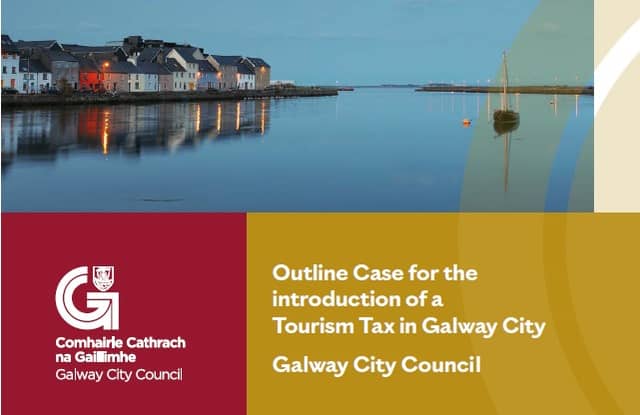

Galway City Council is appealing to Government to allow it levy a ‘tourist tax’ or ‘bed tax’ on visitors. The local authority wants Galway City to become a pilot destination for the introduction of a tourist tax levied on overnight visitors.
Currently, there is no mechanism for local authorities to apply tourist taxes, but there have been calls from Galway City Councillors in recent years to introduce a levy.
The Council wants a three-year trial in Galway City to determine if a tourist bed tax is a viable initiative that can be rolled out across the state.
Officials in City Hall presented a comprehensive plan outlining the business case for the introduction of a tourist tax in Galway City to elected members at their meeting on Monday.
Helen Kilroy, Head of Finance, at Galway City Council, said a “back-of-the-envelope” calculation estimated that a €1 charge per visitor per night could boost City Council coffers by €2 million every year.
This was based on 2.4 million annual visitors to the city, and an accommodation occupancy rate of 77%.
The report noted that some cities that suffer from over-tourism have introduced tourist taxes to control the number of visitors.
This was not the reason for its planned introduction in in Galway, however, and Ms Kilroy said the revenue raised would be ring-fenced to enhance the tourism offering and underpin funding of local infrastructure.
Sally-Ann O’Brien, Galway City Council’s new tourism officer, told the meeting that Ireland was an outlier in terms of not having a tourist tax.
She said that 21 of the 27 EU states have some form of bed tax, as do the US and UK.
Ms O’Brien said international visitors to Galway are mostly coming from mainland Europe (47%), US (27%) and UK (18%) and expect to pay a bed tax.
Chief Executive of Galway City Council Leonard Cleary said he was seeking a mandate from councillors to negotiate for Galway to become a pilot for a tourist tax.
The business case for the tourist tax argued that “tourists as well as local communities should be contributing to the socioeconomic development of” the city.
The meeting heard that tourists benefit from services such as street cleaning – which Councillor John McDonagh pointed out represented an investment of almost €5m per year – but visitors were not paying for those benefits shared with residents and ratepayers.
Councillor Shane Forde (FG) suggested that a city tourism tax could make overnight stays in hotels in places like Clifden or Loughrea more attractive.
Councillor Níall McNelis (Lab) said it was essential that visitors staying on short-term lets such as Airbnbs were subject to the tax, and that it was not confined to hotels.
Councillor Mike Crowe (FF) said he welcomed the idea but he said ”ultimately it is an additional tax and a new tax”.
He urged caution and warned that the “perception” of the tourist tax could do more damage than the financial gain.
Councillor Eddie Hoare (FG) said they should not call it a tourist tax and instead should use the term “bed levy” or “visitor levy” because “it is important how we frame it”.
Councillor Alan Curran (Soc Dem) said it was important that the City Council did not become reliant on this sort of income for “essential services”.
The business case that will be presented to Government, said the tourism offering in Galway City is critical to the West and Wild Atlantic Way.
“Funding for the sector is largely based on an uneven support for the City in the context of its capacity to raise local income and to receive support from the National Exchequer given its designation as an Authority at a similar level to that of the smallest local councils in the State. In the on-going effort to sustainably grow the sector in Galway other funding options need to be examined,” it said.