

University of Galway will focus on cuts in methane

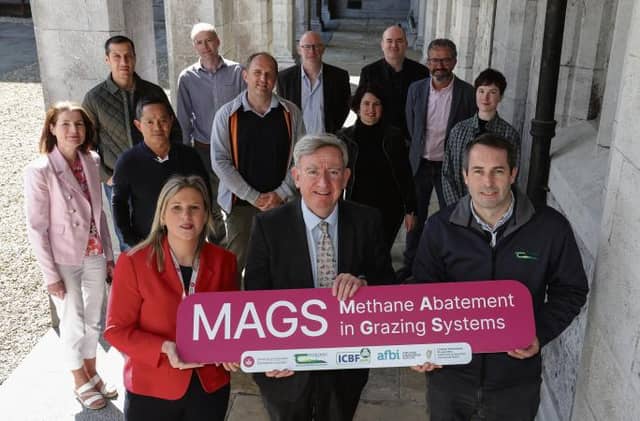

A €1.4 MILLION research project headed up by the University of Galway [UG] will be at the cutting edge of technology aimed at reducing methane emissions from Irish cattle.
The Methane Abatement in Grazing Systems (MAGS) will focus on potential methane reduction solutions in relation to animal feeds, breeding and manure management [essentially slurry].
Teagasc, the Dept. of Agriculture, the Irish Cattle Breeding Federation and the Northern Ireland based Agri-Food and Biosciences Institute (AFBI) will be working with scientists from UG on the project.
Funding for MAGS is being provided by the Dept. of Agriculture with the Minister of State, Martin Heydon, saying last week that the financial commitment was an indication of the department’s ambition to reduce agri-methane emissions.
“The MAGS project will focus on further developing technologies, including methane inhibitors and breeding strategies, for application in beef and dairy pasture-based systems to mitigate animal and manure methane,” said Minister Heydon.
Ireland is committed to reducing greenhouse gas emissions from agriculture by 25% between now and 2030 with ‘novel methane reduction technologies’ expected to play a key role in that cut.
Dr. Sinéad Waters – Teagasc and University of Galway – who is the project co-ordinator of MAGS, said that agriculture was Ireland’s oldest and largest indigenous industry but it now faced ‘a major challenge’ in meeting the 2030 methane reduction target of 25%.
“Strategies to mitigate methane emissions related to cattle and sheep need to be rapidly developed and implemented on farm to comply with these targets.
Pictured: Members of the research teams involved in the Methane Abatement in Grazing Systems project (MAGS) pictured with (front centre), President of the University of Galway, Professor Ciarán Ó hÓgartaigh; along with (left) Dr Sinéad Waters, Project Co-ordinator; and (right) David Kenny, Teagasc Researcher. PHOTO: Aengus McMahon.