

Cyclists want homes in Knocknacarra knocked

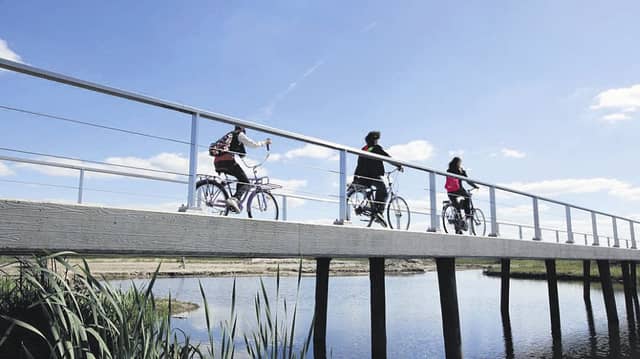

A submission by cycling campaigners about the city bypass believes homes should be demolished in parts of Knocknacarra and traffic banned from three key bridges to transform Galway into the Oxford of Ireland.
The submission by the Galway Cycling Campaign to the Galway City Integrated Traffic Management Programme Consultation – being undertaken by the consultants managing the city bypass project – argues that Galway should move away from car-focused city models such as Los Angeles or Birmingham.
Instead, it should see itself as the Irish equivalent of historical university cities like Oxford, Cambridge, Utrecht, Freiburg and Ferrara.
The cycle lobby group argues for a system of traffic cells modelled on cities like Delft and Groningen with cars banned from crossing the city centre.
The Salmon Weir bridge, O'Briens Bridge and Wolfe Tone bridge would be closed to private cars but remain open to pedestrians, cyclists and public transport. Private traffic crossing the city would need to use the Quincentenary Bridge.
For the wider city, the submission calls for comprehensive measures to address car speeds on city roads with a focus on enforcement.
Problematic road features should be removed or modified – roundabouts should be taken out, traffic calmed with raised zebra crossings and lane widths at traffic lights widened.
The cycle campaign calls for remedial measures for newer car-based areas of the city such as Knocknacarra to allow people to cycle in the shortest route necessary without having to go on main roads.
“Measures will include knocking down walls between housing estates, providing wheeling ramps and steps, providing pedestrian and cyclist access from housing estates to local roads by the shortest possible route. In some locations, particularly Knocknacarra, it may be necessary to buy adjacent properties and demolish them in order to construct the type of secondary roads network found in cities like Utrecht or Freiburg.
“Here the cul-de-sac based housing model needs to be dismantled. In some cases, it may be necessary to purchase properties and demolish them in order to create a functional roads network. Without this, walking, cycling and public transport are discouraged by excessively long travel distances,” the group believes.
Smaller schoolchildren must have traffic-free routes away from main roads to tackle school-run congestion.
In a separate submission, the Community Road Safety Action & Information Network (Cosain) argues that in order to encourage more sustainable travel patterns, planning authorities and their consultants must place public transit, cycling and walking at the top of the transport hierarchy.
“If car dependence is a fire that must be controlled, then increasing road capacity is like dousing it in high-octane fuel,” it states.
The group also rallies against what it describes as the provision of large quantities of car parking (2,634 spaces) in the city centre.
“Yet it is frequently stated by the Local Authority that there is ‘no room’ in the city centre to further accommodate public transport, walking and cycling … the availability of free, cheap or otherwise convenient parking is one of the biggest determinants of whether people drive to their destinations, or travel by bus, by bike or on foot.”