

Creating awareness of addiction
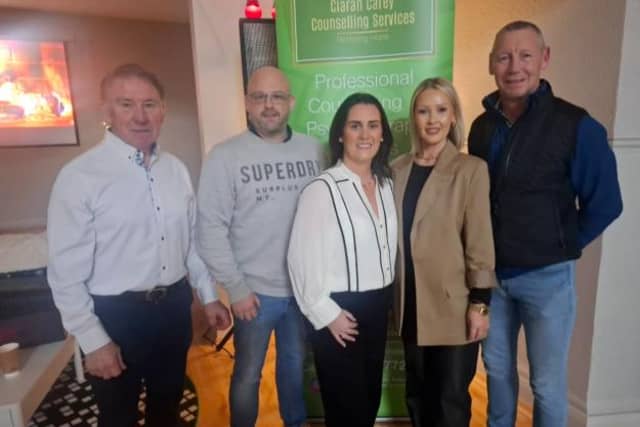

The time has come to move from raising awareness of addiction towards providing support for those affected by the disease – and to equip young people with the tools to avoid addiction in the first place.
That’s according to Killererin-based advocate Olivia Rooney who recently organised the ‘Sure Look, I’m Grand’ event in Barnaderg seeking to facilitate open and honest conversations around mental health and addiction.
Olivia, who is herself in recovery from alcohol addiction, says stigma hampers efforts to support those who ‘fall into its jaws’ – and curtails parents’ ability to broach the topic with their children.
“The event was about empowering young people to make informed decisions, and to allow parents and those in a community to be more open and honest with our own children,” she says.
It came about – explains Olivia, the Chairperson of Killererin Community Council – after Killererin football manager Tom Hughes approached her to organise an event in an effort to prioritise player wellbeing in the community.
“Player welfare is paramount for Tom,” she says, adding that the role of the GAA and LGFA is crucial to lead the conversation in communities. Local TD Pete Roche, for whom Olivia works as an administrative assistant, sponsored the event.
The risk of drug addiction is growing among young people as drug use becomes more normalised within communities.
“It has become quite normal to be using [drugs]. It’s a social thing, like drinking was before. There seems to be a growing social acceptance and not everyone is going to become addicted, but there are people who will fall into the jaws of addiction.
“It’s a progressive disease meaning that people go from something being a social thing into becoming addicted, when taking drugs or drinking is no longer a choice,” says Olivia.
“I chose the title, ‘Sure Look, I’m Grand’, for the event we had because we are conditioned to deflect.
"The event was about gently challenging that culture of silence, creating space for people to say how they’re really doing, and reminding our community that it’s okay not to be okay, and that support is there.”
Among the guest speakers was Limerick hurling legend and addiction counsellor Ciaran Carey, who has been very public on his own struggles with alcohol in the past.
Carey was an outstanding Limerick hurler of the nineties, winning three All-Stars, two Munster titles and two National Hurling Leagues.
But it was after his playing days that he went public on his own addiction issues, and he now holds a BA (Hons) in Counselling and Addiction studies with over 20 years’ experience in the field of addiction and recovery.
Two other speakers alongside Olivia - George Henderson and Linda Daly – also shared their experience of overcoming addiction.
Their honesty was eye-opening for many in attendance, says Olivia, particularly stories about how young people are targeted by drug dealers.
“That real, raw honesty is something we need in communities, schools and clubs.
“Speaking as somebody in recovery, if we go back 30 years, I might have made different decisions if we were more informed. I make that point to my own children – even if you make a bad decision, let it be an informed decision.
“Nobody sets out, planning to become addicted. There are a lot of young people who are not ‘playing the tape until the end’ – if they were to see what life could be like six years down the road, they might make different decisions,” says Olivia.
Mental wellbeing is intrinsically linked with alcohol and drug abuse, she says, and despite the focus on ‘awareness’, this is a fact that is often overlooked when discussion addiction.
Olivia, who went into treatment for alcohol addiction in Hope House in 2020, says alongside her faith and positive affirmations, hearing from others who were in recovery gave her strength in those early days.
“My recovery was found in other people sharing their stories. Speakers come into Hope House and share their experience, strength and hope. No two people’s stories are the same, but the feelings experienced often are.
“I never hesitated in sharing my story but I did have to wait until I was grounded in myself. I don’t shy away from my own experience. nothing gives me greater joy than knowing that sharing my experience could reach somebody who needs to hear it,” she says.
Recovery was not easy, say Olivia, but it has given her the ability to find joy in life again.
“Back in 2019, I hit rock bottom. I was disconnecting myself and isolating myself. I became totally emotionless – I couldn’t find joy in anything. It’s awful to say but I couldn’t even find joy in the embrace of my own children. It was only after I could start to feel again that I realised that,” she reveals.
“The hardest part for me was accepting I had a problem. The amount of relief I felt when I finally accepted it was incredible.
"I had a lot of stuff to process but I realised that once I am sober, I feel anything is possible,” adds Oliva, who is now in the final year of a degree in counselling and psychotherapy.
The Barnaderg event is something that could be replicated in communities across Ireland, she says, and it is conversations such as the ones they had that could pave the way for a more honest discussion about addiction in this country.
"What makes this particularly special is the role of the GAA and LGFA in promoting player welfare, mental health awareness and looking after the whole person — not just performance on the pitch. Seeing our clubs lead this conversation sends a powerful message,” says Olivia.
“I would love to see other communities replicate it. There is a stigma around addiction, and even a hesitation to attend an event like this. But I think it’s all about providing knowledge – putting it all out there and doing it in plain English, and attaching real lived experience.
“I think we are beyond raising awareness. We need to move on and see how to navigate this in the world we live in.”