

From Gurteen to Gaza - The story of a number of Connemara men who died or were killed in World War 1


Archaeologist and historian Erin Gibbons focuses in on one in particular – John McDonagh of the Connaught Rangers, who died in Palestine in 1918 and whose remains are interred in Gaza
The imperial history of World War 1, which is still impacting our world today, can be read through the war memorials and grave inscriptions of dead soldiers in the many former War Zones of WW1 from Ypres in Belgium, to Gallipoli in Turkey and as far away as Bagdad in Iraq.
While more names will emerge in time, this article lists nine men and focuses on the lives, deaths and memorials of four of them from the immediate Roundstone area of Connemara, including that of Private John McDonagh, who died in Palestine in 1918 and who is buried in Gaza.
Private, Owen Gorham, son of John and Annie Gorham, was born and reared on Inishnee, Roundstone. A member of the 2nd Battalion, Irish Guards and aged 24 years, he was killed in action near Ypres, Belgium, on July 31 1917.
On the same day and in the same general area, near Ypres, Francis Ledwidge (1887-1917) the Irish poet and Welsh poet Hedd Wyn, also known as Ellis Humphrey Evans, (1887-1917) were also killed. It was the first day of what is referred to as the Battle of Passchendaele. All three are buried at Artillery Wood Military Cemetery in Belgium.
Also named Gorham, from Dolan townland, Roundstone, was Martin, the son of Valentine and Mary Gorham. He was one of eight children and was working as a farm labourer by the time of the 1911 census when he was just 13 years old.
He became a private in the 2nd Battalion, Leinster Regiment and was killed in action on June 18 1918, aged 21 years. Valentine, his father was awarded a dependant’s pension of 10/- per week from 1919. He is commemorated on the WW1 Ploegsteert Memorial in Wallonia, Belgium with over 11,000 men who died in that region who have no known grave.
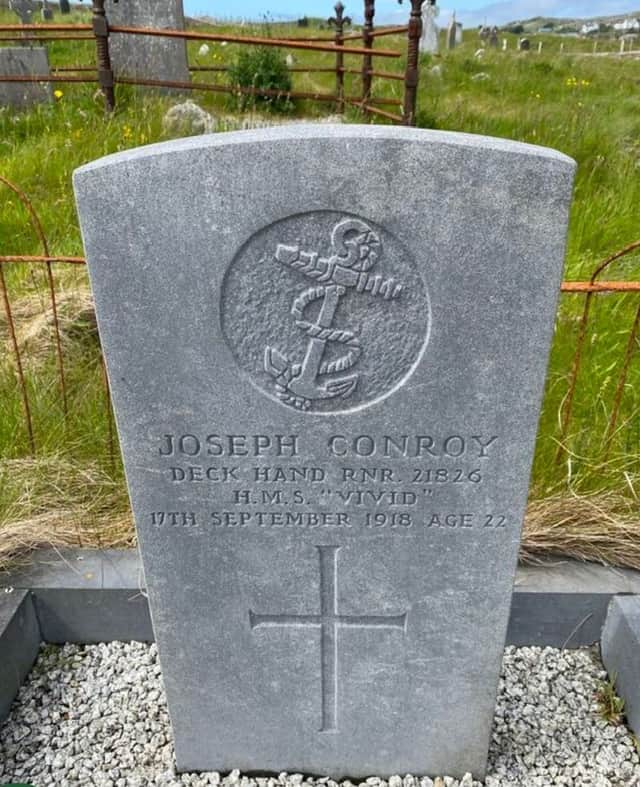
Royal Navy Reserve member Joseph Conroy (1896-1918) was the son of John Conroy, a Roundstone carpenter and his wife Honor King.
He was a deck hand in the Royal Navy Reserve, based at the HMS ‘Vivid’ Naval Barracks, in Devonport Royal Navy Base, Plymouth, England, where he died on September 17 1918.
Don Kindell, historian & researcher of Royal Navy and Dominion Navies, lists him as dying of ‘illness’. Four of his shipmates also died of ‘illness’ on the same day.
At that time, a second wave of the 1918 Flu Pandemic had arrived in Plymouth and it is likely that it was the cause of the death of the young men. His Grave/Commemoration is in Gurteen Cemetery, Roundstone.
It was erected by the Commonwealth War Graves Commission (CWGC). The Galway Great War Memorial website however, lists Joseph Conroy as ‘’dying of his wounds”.
Private John McDonagh (1894-1918) was born in Fonacree, also known as Founachree, Murvey townland, Roundstone overlooking the beaches of Dog’s Bay and Gurteen and Gurteen Cemetery, in the neighbouring townland of Errisbeg West.
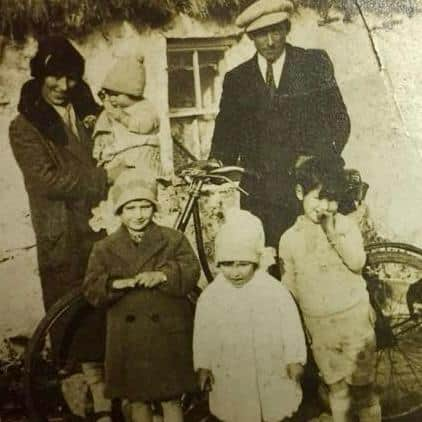
John was one of ten children of John McDonagh (Snr) and his wife Barbara Keane. John (jun) was an older brother to Tom McDonagh, who lived in Fonacree until the 1980s.
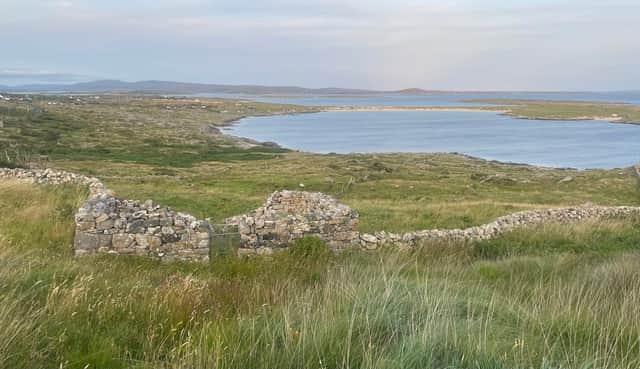
John McDonagh, parents and siblings, are listed in the Census as speaking English and Irish in 1901. By the time of the 1911 census John (Jun). was aged 16 and a scholar.
The CWGC record Private McDonagh’s parents address as Murvey, Roundstone. An Army Index record gives John’s address as Dumbarton, while his parents John and Barbara McDonagh continued to reside in Murvey. At the time, Dumbarton, on the river Clyde, west of Glasgow, was a popular destination for Connemara migrants and emigrants.
John was a Private in the 1st Battalion of the Connaught Rangers and his place of Army Service is listed as Egypt where the 1st Battalion formed part of the Egyptian Expeditionary Force under the leadership of Field Marshal Edmund Allenby. They disembarked at Suez, on April 14 1918 having travelled from Iraq.
The ‘Private John McDonagh (5911)’ under discussion, should not be confused with another Private John McDonagh (6520), a Roundstone native who served in the British Army in WW1 from 1915-1917, with the Connaught Rangers and the 8th Battalion Royal Munster Fusiliers.
He was prosecuted in Roundstone in 1920 and spent one month in Galway Gaol for committing the felony of unlawful assembly, with intent to break into the RIC Barracks in Roundstone during the War of Independence.
A copy of Private John McDonagh’s (5911) informal, hand-written ‘Soldiers Will’, written on June 29 1918, survives in the National Archives in Dublin. The original would have been on his person, written into his pocket service book.
In 1919 the document was validated by the British War Office, confirming he left all of his property and belongings to his mother. It also states that he died in Palestine on November 10 1918.
McDonagh’s full service record has not come to light. It is not possible therefore to establish whether he took part in earlier campaigns of the 1st Battalion, Connaught Rangers in Palestine, France and Flanders, or in Mesopotamia. In his army career, he earned the Victory Medal and the British War Medal. WW1. On his death, his family was given a Memorial Death Plaque.
The Connaught Rangers Association website tracks the military manoeuvres of the 1st Battalion, Connaught Rangers in Palestine in 1918 after they left Egypt and the Sinai.
By following it, we can track the final movements of Private John McDonagh in the last seven months of his life, which coincided with the last seven months of WW1.
From May until September, the 1st Battalion did tours of duty on the Front Line that stretched across Central Palestine between Jerusalem and Nablus.
On September 19 1918 Field Marshal Allenby resumed his northward offensive to take the rest of Palestine. Caught by surprise and unprepared, the Turkish/German army fell into a disorganised retreat and within two days the Turkish HQ garrison at Nazareth was captured.
The 1st Battalion, Connaught Rangers took an active part in this offensive, involved in heavy fighting at the taking of ‘Fir Hill’ (near the village of Kefr Saba) on the advancing Front north of Jaffa.
At the town of El Funduk (in the northern end of the Occupied West Bank ,Palestine) the Rangers captured a Turkish artillery column intact. It was the 1st Battalion’s final action in the Great War. In late September they were garrisoned at Jenin, Palestine and later moved in to garrison Nazareth.
The Rangers remained in Nazareth as the battalion was badly affected by 'a malignant type of malaria' later known as the 'Great Influenza Epidemic'.
As the 1st Battalion was garrisoned at Nazareth in November 1918 at the time when the outbreak of the killer Flu Pandemic had struck there, it is likely that the death of Private John McDonagh on November 10 1918 resulted from contracting the Flu Pandemic in Nazareth.
Listed in an ‘Index of Dependant’s Pensions’, his stated cause death is ‘Pneumonia’. Most people who caught the 1918-1919 Flu died of Pneumonia, as a secondary infection.
The fighting in Palestine ended a mere eleven days before his death with the signing of the Armistice of Mudros on October 30 1918, between the Ottoman Empire and the Allied forces, on the Royal Navy Ship HMS Agamemnon.
Vast areas of the Middle East, including Palestine, controlled by the Ottoman Empire for over 400 years, came under allied control. The overall Armistice was signed near Paris on November 11 1918, just one day after the death of Private John McDonagh.
An estimated seventeen million people died in World War 1, of whom from nine to eleven million were military personnel, the rest being civilian casualties.
Private John McDonagh is buried in Section B. 196 of the Commonwealth War Cemetery, Deir El Balah, by the village of Az-Zawayda, near the Mediterranean Coast of Gaza. It is one of three Commonwealth War Graves Cemeteries in Gaza in the State of Palestine. It contains the graves of 724 Allied soldiers in total.
Major damage to all three cemeteries by Israeli forces has been documented since 2023. Many men from Scottish and Welsh Regiments are buried in Section (B) near Private John McDonagh. Section (C) contains the grave of Sligo native, Private T. Kennedy,1st Battalion Connaught Rangers.
While over 75,000 people, mainly innocent civilians, have been killed by Israeli forces in Gaza since 2023, the detail of the cultural destruction by Israel, of the physical record of civilisation in Gaza, is only beginning to be collated and evaluated.
A report released in March 2026 by the Geneva based ‘Euro-Mediterranean Human Rights Monitor’ makes for disturbing reading.
The Euro-Med Monitor team found that the Israeli army completely bulldozed and destroyed graves in 39 cemeteries in Gaza and partially damaged 19 others. Only four cemeteries remain intact.
Subsequently UNESCO confirmed the levels of cultural destruction, including massive damage to 14 religious sites, buildings of historical and/or artistic interest, museums, galleries, monuments and archaeological sites.
The Euro-Mediterranean Human Rights Monitor list and the UNESCO list both include the Deir Al Balah cemetery, at Az-Zawayda, thereby placing it among the targets of cultural erasure being committed by Israeli forces which amounts to cultural genocide.
Contacted by the writer in June 2026 on the matter of John McDonagh’s grave in the Commonwealth War Grave Cemetery in Deir Al Balah, at Az Zawayda, a spokesperson for the CWGC responded on June 24.
"I am so sorry, but I have been unable to locate a photograph of the grave of Private John McDonagh, as we do not hold photographs of all of the graves in our care," they wrote.
"We are deeply saddened by the damage to our cemeteries in Gaza, where fallen from both the First and Second World Wars are buried. We currently estimate that around a third of both Gaza War Cemetery and Deir El Balah War Cemetery have suffered extensive structural damage," they added.
It is the actions of the Egyptian Expeditionary Force in 1917 and 1918, of which young Private John McDonagh was part, that created the conditions that allowed for the subsequent establishment of the State of Israel.
It is therefore ironic that the same Israeli state should treat the cemeteries and mortal remains of these men with such callous disrespect