

Support is vital when life-altering illness hits
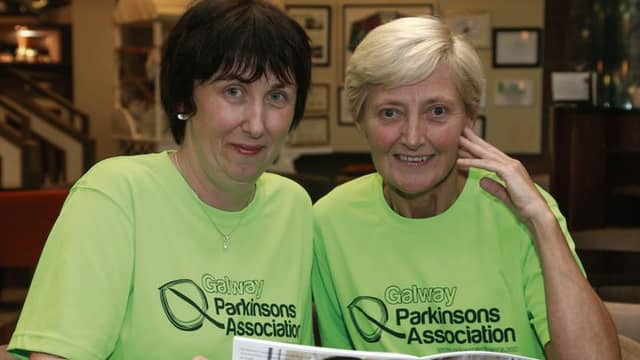

Lifestyle - Dearbhla Geraghty talks to the people behind Galway Parkinson’s Association which provides assistance to 200 families
The diagnosis of any life-altering disease can be devastating for the most resilient of us, but through the voluntary work of the Galway Parkinson’s Association, the path for patient and family has utterly changed for the better.
It is certainly all-heart that drives the charity’s current chairperson and secretary, Marie Cahill and Caroline Rushe. Both saw a parent suffer with this disease in a time when the public services were insufficient, and knowledge and support were in short supply.
Now, it is not over the top to say that these two women dedicate their lives to improving the lot for others – years after the death of their own loved ones.
“When he was diagnosed, and said ‘I have Parkinson’s’, none of us knew what it was… we hadn’t a clue,” Caroline recalls the early days of her father’s journey with the disease, which began in the early 1990s.
Subsequently, Vincent Rushe, was one of about six men brought together by social worker, Maggie King, to form a support group in the city.
It eventually expanded to become what is now the Galway Parkinson’s Association, but it may have been the arrival of Paddy Browne, a nurse specialist from Monivea, that started the charity on its current path.
“Ann O’Connell was our chairperson in the early 2000s, and was really trying to develop things, she could see the bigger picture, and was very progressive,” Caroline says.
“Paddy came to one of our meetings, and he said that he was going to the UK to get trained as a Parkinson’s Disease nurse. I was in awe of him, and we gave him a couple of hundred Euro towards his training.
“He really gelled the whole Parkinson’s thing – all of a sudden we were something, and people were beginning to recognise us more.”
It was in the charity’s early days that Marie Cahill came looking for help when her mother, Kitty, was diagnosed at just 52 years of age.
“It was a whole new experience, and we didn’t know what was going to happen – we didn’t know anything,” she recalls.
“I wasn’t even in my 30s, and my Mum had very progressive Parkinson’s, she needed 24-hour care, and couldn’t communicate or walk.
“At the first meeting I went to, I was thinking ‘what am I doing?’ but I found support in that I could relay some of what was happening at home and ask questions – they became my other family.”
The charity, which receives no government funding and relies entirely on donations and fundraising to meet its annual costs of around €50,000, could only go so far, however – dealing with the public service would be its biggest challenge yet.
For a start, Paddy Browne was only employed as a specialist nurse on a temporary basis by the HSE.
“We had to make sure he was in full time employment – he was the link between the consultant and patient – so we spoke to Noel Grealish TD, who organised a meeting with Mary Harney (Minister for Health),” says Marie.
“I assumed that I was only going as support, and that Dr Tim Counihan (consultant) would be meeting with the Minister, but I was allowed in and to give my input.
For more, read this week’s Connacht Tribune.