

Sport is tough but we have to try and ‘mind our heads’


Country Living with Francis Farragher
Back the years I’d never have considered myself a softy in sport being able to defend my goalposts and small square in an era when bustling full forwards in the GAA or the number nines in soccer would often try give a ‘good early rattle’ to a keeper.
Overall, the injuries were never too bad . . . a few cracked ribs here . . . one or two concussion checks . . . the odd shot blocked here and there where it hurt most for a male . . . and the occasional ankle sprain.
A couple of weeks back, I was looking ‘on the box’ at Leinster and Bath playing out quite a riveting rugby encounter and here and there was inclined to shudder at the intensity of the physical contact. Kind of thought to myself, surely this cannot be good on such a regular basis.
In one incident, Leinster scrum-half, Jameson Gibson Park was met head-on by an opposing Bath player, not necessarily deliberately, but the contact was quite intense. The Leinster no. 9 had to go off for the usual HIA (head injury assessment), and I thought we won’t see this guy in action again tonight.
Into the bargain he had quite an ugly looking, deep wound under one of his eyes, but 10 or 15 minutes later, he lands back on the pitch in sprightly form and to cap it all off, scores an absolutely brilliant individual try. We had a similar type incident in the recent Ireland-Scotland international at The Aviva, when two Scottish players had a quite shocking collision of heads.
The sport of rugby is doing it’s level best to minimise any contact, at or above, shoulder level, but yet it surely has to be one of the most physically gruelling sports in the world.
True, there could be nothing but sheer admiration for the courage and recovery of the likes of Gibson-Parke that evening in The Aviva, but I do have a sneaky hunch that all those hits players can absorb, while being super-fit and free of fear in their 20s and 30s, just can’t be good for them in later life.
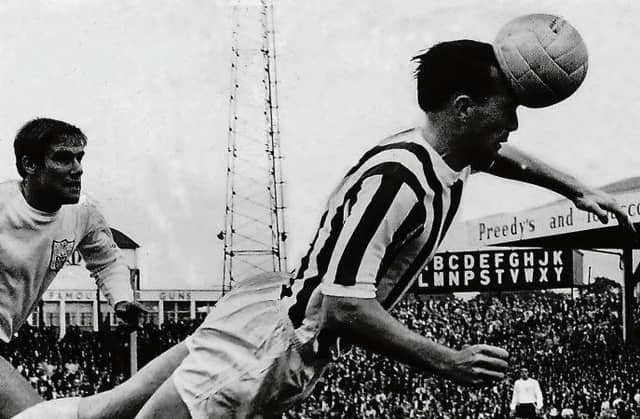
Soccer too, even allowing for the feigning of injuries by some of its overpaid and pampered superstars, is not without its risks and a few years back, I remember reading about Jeff Astle, who played at centre forward for West Bromwich Albion, at a time when many of us followed our glory team of that era, Leeds United.
Pictured: One of the most famous headers of the ball in English soccer during the 1960s and 1970s – West Bromwich Albion’s Jeff Astle – pictured in typical pose against Fulham, in a 1966 league match. He passed away at the age of 58, having suffered from Alzheimer’s Disease for a number of years.