

Overcoming obstacles – Afshin’s refugee story

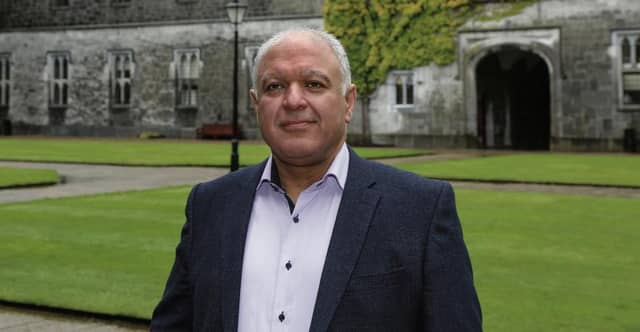

Lifestyle - Afshin Samali who is Cancer Biology Professor at NUI Galway arrived in Ireland as a 17-year-old refugee after his family fled his birthplace of Iran leaving all their worldly possessions behind. He spoke almost no English when he came here. Today, his cutting-edge research work at the university is offering new hope to people with cancer. He is also supporting people who have recently come to Ireland as refugees. Afshin is drawing on his own experience and his Baháʼí faith for this humanitarian work as JUDY MURPHY learns.
When Iranian-born Afshin Samali moved to Ireland as a 17-year-old refugee in the late 1980s, his Baháʼí faith made a traumatic move some bit easier.
“Earth is just one country and mankind is its citizens,” he says of its core philosophy. “The whole world is our homeland and we work for its betterment.
“I was born in Iran and I carry its history, culture and language with me, but now I live in Ireland and here is my home, where am using the good things I have to help the next generation.”
He certainly is. As Professor of Cancer Biology and Director of the Apoptosis Research Centre at NUI Galway Afshin is a leading light in cancer research, helping to spearhead new treatments for the illness.
That’s no small achievement. But what makes it more remarkable is that when the teenage Afshin arrived in Ireland with his family, he spoke almost no English.
He was just 15 years old when his family fled Iran – where the fundamentalist Islamic regime of Ayatollah Khomeini had recently taken hold.
Afshin’s family were members of the Baháʼí faith, Iran’s largest minority religion, but one that isn’t recognised by that state.
Established in the 19th century in Persia (modern-day Iran), by Baháʼu'lláh its main tenets are the unity of all religions and of humanity.
Even under the Shah’s regime, Baháʼís had faced sporadic persecution, because they believe Baháʼu'lláh was a prophet and the Islamic religion accepts no prophet after Muhammad. But pressure from the West had kept that under control, he explains.
However, under the Ayatollah’s fundamentalist regime, persecution reigned. Afshin’s mother, Susan, a primary teacher in a state school was forced from her job.
Likewise with his stepfather, Iranpour, whom Susan had married after Afshin’s father had died some years previously. Iranpour, a vet, was barred from holding any public sector job. They would only get employment if they renounced their faith.
For more, read this week’s Connacht Tribune.
Connacht Tribune Digital Edition App
Download the Connacht Tribune Digital Edition App to access to Galway’s best-selling newspaper.
Click HERE to download it for iPhone and iPad from Apple’s App Store, or HERE to get the Android Version from Google Play.
Or purchase the Digital Edition for PC, Mac or Laptop from Pagesuite HERE.
Get the Connacht Tribune Live app The Connacht Tribune Live app is the home of everything that is happening in Galway City and county. It’s completely FREE and features all the latest news, sport and information on what’s on in your area. Click HERE to download it for iPhone and iPad from Apple’s App Store, or HERE to get the Android Version from Google Play.