

Insight into a bygone era

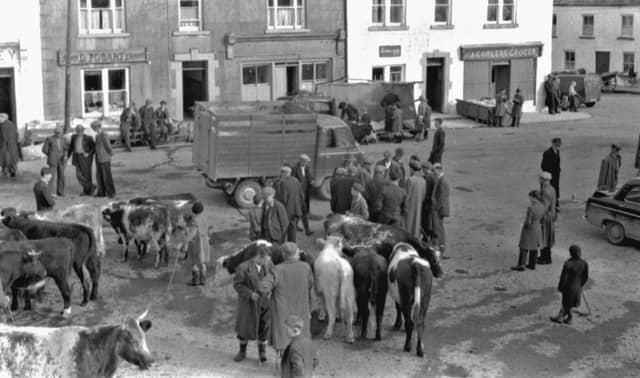

A new exhibition opening next week in Kinvara gives a glimpse into life in rural Ireland in the 1950s, before the country changed rapidly in the following decades. JUDY MURPHY hears of the treasures left by an American anthropologist who studied the area in the mid-1950s.
It’s courtesy of American anthropologist Robert Cresswell (1922-2016), who spent several months in the area during 1955 and 1956, when he took about 500 photos of people going about their daily lives
This exhibition of 30 of his photos, entitled ‘Cresswell’s Kinvara’, is being presented by Kinvara Heritage Group in conjunction with the Community Council. It follows a previous show of his work in 2025 that was so popular people asked for more.
Cresswell who served in the US Army during World War II, settled in France after the war. Having received a grant to study in the Sorbonne University, he chose anthropology.
Rural Ireland attracted his attention. Having originally intended to study life on Achill Island, he picked Kinvara on the suggestion of the Head of the Irish Folklore Commission, Séamus Ó Duillearga.
The result is a priceless collection of photos which offers an extraordinary insight into the life of this farming and fishing community before Irish society changed completely.
After his time in Kinvara, Cresswell returned to France, and his study of the area was eventually published in 1969. The photos he’d taken as part of his field work for ‘Une Communauté Rurale de l’Lirlande’ / ‘A Rural Community in Ireland’, are now in the ownership of Kinvara Community Council, thanks to local man, Caoilte Breathnach.
Caoilte, who has a passion for local history, first discovered Cresswell’s images while working on a book with local publisher Anne Korff of Tír Eolas Press, which was published in 1997. While researching ‘Kinvara: A Seaport Town on Galway Bay’, he came across some of the images and they piqued his interest. Caoilte managed to contact Cresswell, who was living in Paris, and they stayed in touch.
In 2006, Caoilte visited the anthropologist and discovered the extent of the archive. In addition to about 450 black and white pictures, it contained colour slides and 16mm film, all captured during those months in the 1950s. As their friendship strengthened, Caoilte asked Robert Cresswell if he’d consider donating the archive to the community that had inspired it. In 2010, that’s what happened.
Caoilte recalls travelling to Paris to collecting the original notebooks, negatives, slides, film and maps, which Cresswell had prepared for him. He got so engrossed in chatting with Cresswell and his wife, Martine, that he almost missed his flight back to Shannon.
Cresswell’s study of Kinvara was in French and while it might be translated sometime, the photos matter more. “A visual version of oral history”, is how Caoilte describes them. “People relate more emotionally to photos than to words.”
Anthropologist Anne Byrne of the University of Galway, agrees, describing Cresswell’s book as “an academic work”. She, along with Caoilte, Fran O’Reilly and other members of the Kinvara Heritage Group are putting the final touches to next week’s exhibition.
Fran got involved with this project “by mistake,” she says laughing. It was through her husband, who’s a director of the Community Council. She travelled to Dublin early last year to collect 30 high-quality, framed colour Cresswell images, which the National Museum of Ireland had donated to the Kinvara community. These large works featured in a show that opened in the Museum in late 2019, curated by Galway based geographer Fidelma Mullane. It attracted a great response before Covid ended it prematurely.
Caoilte praises Fidelma and the Museum for bringing an extra richness to Creswell’s legacy by creating those largescale images – most of his work doesn’t lend itself to being enlarged.
However, some of the black and white images have been enhanced and colourised and feature in the book, ‘The Irish Farm in Colour’, published last year by Gill Press.
As a fellow anthropologist, Anne Byrne stresses that Cresswell was not an arts photographer, nor was he a journalist. The photos he took in and around Kinvara were an ‘aide memoir’ for his study of the people and their lives.
“It’s what’s happening in front of his eyes,” she says.
She describes herself as “kind of stunned by the fact of his gift”, stressing the importance of the ‘gift relationship’ in anthropology.
Cresswell’s generous donation “has a special quality” and has allowed local people to have greater involvement in the project, Anne feels.
“It’s a collective gift, placed in the trust of the collective, where people can manage it themselves.”
And locals have helped to create an awareness of the work since it was gifted. A selection of the photos – both colour and black and white – can be seen on the kinvara.ie website, thanks to the labours of people like Declan Connolly and Paul Dunne.
Grouped under various headings – ranging from ‘Elections’ to ‘Picking spuds’ to ‘Kinvara families’, ‘On the Street’, ‘Harvest’, ‘Jack Burke’s Forge’ and ‘Miscellaneous’, they are there for everyone.
Meanwhile, in 2010, shortly after the archive arrived in Kinvara, TY students in Seamount College, aided by their teacher Pat Conole, held an exhibition in Conole’s Pub in the village. Later that year, a slide show took place in Johnston’s Hall.
The attention the photos have attracted since the beginning hasn’t waned. With the help of people like designer, Paul Reid, calendars of the images have been produced and sold, helping to contribute to the collection’s upkeep. In 2013, local artist Mark Dwyer held an exhibition based on the photos. Caoilte spoke to Cresswell at that time, when he recalled his days locally. People who didn’t know who he was would sometimes start speaking Irish if he walked into a pub – in case he was there on tax business. He also recalled parents using Irish if they didn’t want their children to understand them.
The contribution by fellow anthropologist, Anne Byrne to collating and displaying this work has been enormous, Caoilte says.
“I’m just an amateur; she’s brought in the professional side of things.”
Anne established links with the University of Galway, where staff from its Special Collections section embraced the project. Scanned images of the original negatives are in the university, while the film is with the Irish Film Archive.
The aim of the Community Council, which has the final say on how the material is used, is that it’s available for free for heritage and community projects, with a charge for commercial projects.
Meanwhile, the opening of Cresswell’s Kinvara, is next Friday at 7pm in the courthouse. All welcome.