

Galway In Days Gone By

1925
Tackling poteen
A Government order, the provisions of which are of a drastic and far-reaching character, has become laws this week. It affects nearly every member of the community in County Galway, and as it is not generally known, we think it right, for the information of the public, that it should have widespread publicity.
The order, which comes into force under Section 26 of the Intoxicating Liquor (General) Act, 1924, requires every person who wishes to procure any of the following articles to get a permit, in the first instance, from the Chief Superintendent of the Civic Guards: molasses, golden syrup, brown sugar, malt, yeast, hops and treacle.
The order, which came into force last Tuesday, has been found to be an absolute necessity in this and other counties where poteen manufacture has developed into a profitable “industry”.
Up to this week persons might trade with impunity in any of the articles mentioned above, but henceforth possession of them without a permit will constitute an offence, the maximum fine for which is £50, or alternatively, imprisonment and the confiscation of the material and the conveyance in which it is found.
For instance, if a farmer leaving Galway for Connemara has a quality of malt, yeast or even brown sugar for the Christmas pudding in his donkey and cart, without the necessary permit, he leaves himself open to the seizure and confiscation of his cart and everything that it contains, and a fine of £50 subsequently in the District Court.
1950
Potato protest
A strong protest against the margin of profits alleged to be enjoyed by exporters of seed potatoes grown in East Galway was made by Mr. P. Collins, chairman of the Galway Potato Growers’ Organisation, at a meeting of the County Galway Committee of Agriculture on Saturday.
In soliciting the support of the County Galway Committee for the potato growers in their stand against exporters, Mr. Collins said that the growers were saying that they would not grow seed potatoes in future if they did not get a fairer deal.
Mr. C. J. Kerin, chairman, said that the profit (£6 per ton) was too much out of any industry in this country.
There was, said Mr. Collins, a marketing board dealing with the support of seed potatoes. This board was constituted of ten members, seven of whom were representatives of the Department of Agriculture, and only one of whom was a potato grower. The Potato Growers’ Organisation had written to the Minister for Agriculture and he had furnished them with the prices paid to the exporters for the potatoes delivered onto the boats. According to the figures supplied, the exporters had a big margin of profit.
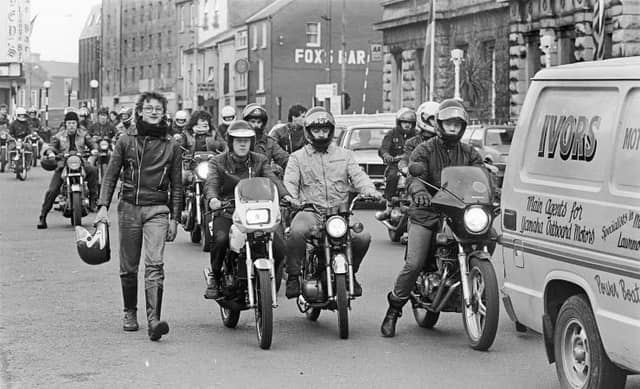
Pictured: FULL THROTTLE - Motorcyclists in Galway City, on November 2, 1985, protesting against a 75% to 300% increase in bike insurance and a ban on pillion passengers.