

Charting role of plough in history of rural Galway


Country Living with Francis Farragher
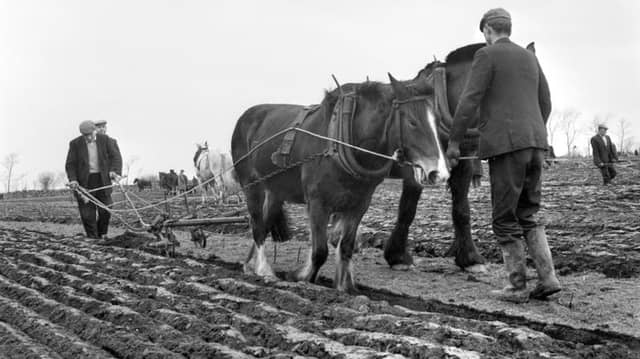
It’s over half a century since I saw the first scrape being turned by a single plough in a field of soil. By today’s standards, the field was little more than a large garden but it regularly produced outstanding crops of potatoes. There should have been two horses pulling the plough but this was soil with no thick skin of knotted grass to cut through, and my father was in charge of just a single horse, but a magnificently strong animal he was.
We used to call him a full black even he did have a white streak that ran from the bottom of his ears to his nose, and while his strength was never in question, his temperament certainly was, and he normally had to be ‘led’ by a neighbour with a strong arm to keep him in check.
There always seemed to be gulls around to feast on the worms and grubs that were roused from their soil portholes but there was something magical about that resonance between humans, horse and nature. As the years passed, the horse was confined to the more manageable tasks for a single animal, namely that of opening and closing drills, scuffling, moulding the potatoes, and of course the work of the Summer and harvest periods such as bringing in the hay and oats.
Loads of those memories came flooding back last week as I glanced through Tom Fahey’s book, A History of Ploughing in County Galway, that was launched earlier this month at the Arches in Claregalway, at an event that I attended. Like a lot of other people, I was quite stunned at the turnout for the book launch with over 200 people in attendance, so the lure of the plough and the land is still quite strong through the homesteads, fields and boreens of Galway.
This week in the village of Screggan just outside Tullamore, nearly 300,000 people will visit an event that is now regarded as the biggest outdoor gathering in Europe, but as Tom Fahey recounts in his book, it all started from very humble beginnings back in the early 1930s when the then Taoiseach, Éamon de Valera, visited the championships in 1933.
For more, read this week’s Connacht Tribune.
Get the Connacht Tribune Live app The Connacht Tribune Live app is the home of everything that is happening in Galway City and county. It’s completely FREE and features all the latest news, sport and information on what’s on in your area. Click HERE to download it for iPhone and iPad from Apple’s App Store, or HERE to get the Android Version from Google Play.